

Summary
What is IKEA’s As Is and Buy-Back Program?
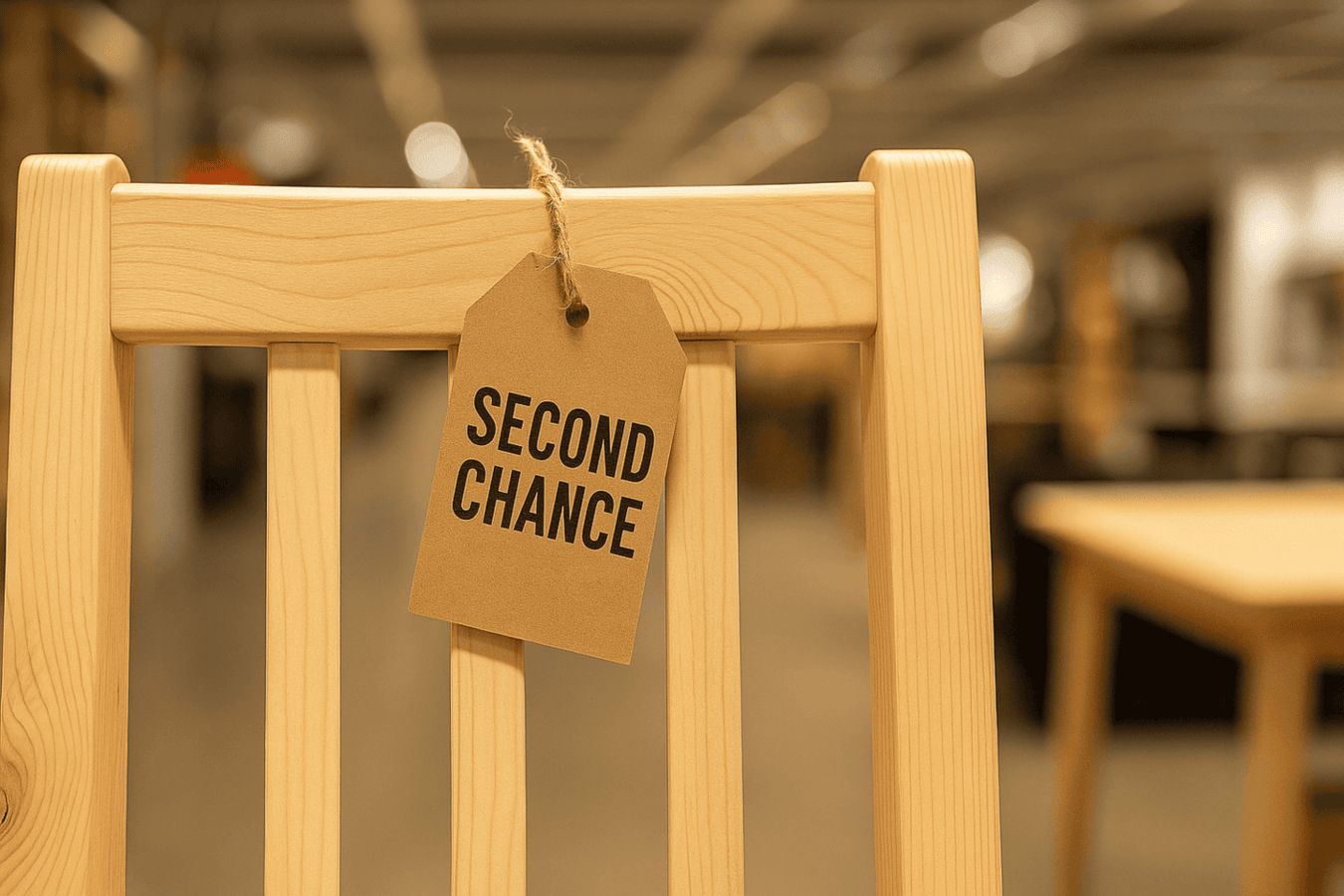
The program is simple on the surface: customers bring back their gently used IKEA furniture, and in return, they receive store credit. IKEA either resells the item in its Second-Chance Market, also known as the As-Is section, or recycles it.
But behind that simplicity is a sophisticated operational system that touches everything from customer experience to reverse logistics to material recovery. It’s IKEA’s answer to the circular economy, and it’s already showing results.
Since launching in select markets like Sweden and the UK, the program has expanded rapidly. By the end of 2024, it was live in 33 U.S. stores and had already engaged over 211,600 customers in 2023, double the participation from the year before.
The program’s origins go back to IKEA’s early announcement in 2019, when the company began positioning itself as a circular leader. Since then, it has grown from a pilot into a global business strategy.
Curious how this works without IKEA’s budget? Our Recommerce Playbook walks through the full setup, from returns to revenue.
How does the program work?
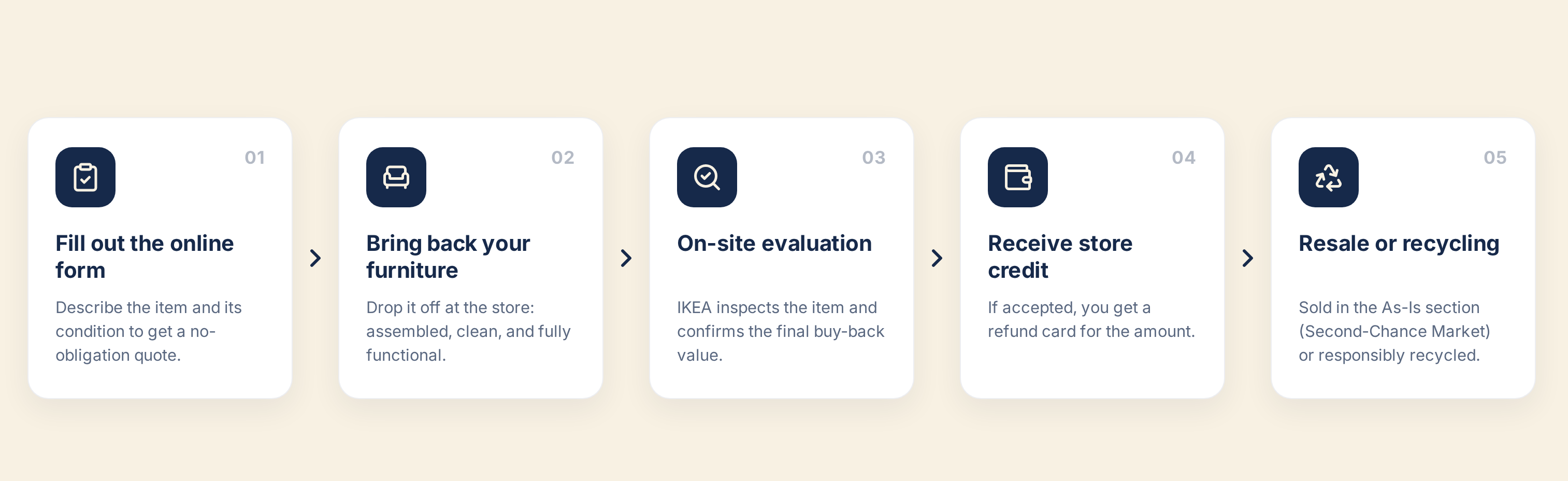
The process is simple:
- Submit an online form – Customers describe the item and its condition to receive an estimated quote.
- Bring the furniture to a store – Items must be assembled, clean, and fully functional.
- On-site evaluation – IKEA staff assess the item and confirm the final buy-back value.
- Receive store credit – If accepted, customers receive a refund card for the agreed amount.
- Resale or recycling – Items are sold in the Second-Chance Market or responsibly recycled.
Not all items qualify. Sofas, mattresses, and heavily worn or modified products are excluded. But common items like tables, chairs, dressers, and storage units form the backbone of the returns.
Are buy-back programs economically attractive?
What makes this model so compelling is that it’s commercially viable, even at IKEA’s scale.
According to what its parent company Ingka Group revealed in its sustainability report, in 2023, the company sold over 263,000 Second-Chance items through online reservation alone, up from just 70,000 the year before.
Meanwhile, the program helped contribute to a 24.3% reduction in IKEA’s climate footprint, while overall revenue climbed by 30.9%.
Even without precise profit margins on the buy-back operation, the direction is clear: customers are buying into circularity, and IKEA is monetizing it.
Beyond resale revenue, there’s also brand loyalty. A customer who brings back an old shelf and gets €40 in credit is highly likely to spend more than that on a new one. The return becomes the start of a new purchase cycle, not the end.
The company even uses flagship moments like Black Friday to promote its Second-Chance model, positioning resale as an alternative to overconsumption. It's a smart reframing: less waste, more value.
From case study to your own program
The Recommerce Playbook shows step by step how to set up trade-in, refurbishment, and resale for your products. Developed by koorvi and INDEED Innovation.
👉 Get the playbook
What other businesses can learn from IKEA
IKEA isn’t alone in experimenting with circularity. But it’s one of the few companies proving that take-back and resale can work at scale, not as a marketing initiative, but as a line of business.
And the key to that success? IKEA isn’t treating returned furniture as waste. It’s treating it as inventory. The Second-Chance Market isn’t a clearance bin. It’s a curated retail experience that fits seamlessly into the IKEA ecosystem.
It demonstrates how take-back systems can:
- Generate new revenue streams
- Create more customer touchpoints
- Lower procurement and material costs
- Strengthen brand image and customer trust
Other industries, especially in furniture, home appliances, textiles, and even industrial equipment, should take note. If a company like IKEA, with millions of SKUs and a global footprint, can operationalize second-life products, so can you.
Launch your own take-back system with koorvi
Of course, not every company has IKEA’s infrastructure. That’s where koorvi comes in.
Our platform gives brands the tools they need to launch and scale their own buy-back or trade-in programs. From customer return portals to automated product evaluation and resale workflows: koorvi helps businesses turn returned items into revenue, not just risk.
With integrations into logistics, inventory, and customer systems, koorvi powers circular models that don’t just sound good. They run efficiently.
- Easy return processes via web form
- Automated evaluation and sorting
- Real-time tracking and workflow automation
Ready to build your own buy-back program?
Circular business models aren’t a trend. They’re the next wave of competitiveness.
IKEA is proving that resale and returns can be a strategic growth lever, not just a sustainability box to check.
If you're ready to reclaim more value from your products, strengthen customer loyalty, and lead in circularity, koorvi is your partner.
👉 Contact us here and let’s build your Second-Chance Market
Not ready to talk yet? Get the Recommerce Playbook or start with the Circularity Check.

%201.avif)