

Summary
What Is the Dyson Trade-In Program?
The Dyson Trade-In Program is Dyson’s central approach to actively extending the lifecycle of its devices and reclaiming value after first use. Instead of letting old devices circulate uncontrollably on the market, Dyson creates a structured take-back process in which customers can register their vacuum cleaners, air purifiers, or hair-styling devices online and send them in. After a transparent assessment of the device’s condition, they receive model-dependent cashback, and Dyson assumes full responsibility for the product’s second life cycle.
Updated in June 2026: this article now covers Dyson’s US in-store trade-in and the program’s current terms.
Why and How Was the Program Launched?
Dyson officially launched its trade-in program in 2025 and has been expanding it ever since. The idea arose from market pressure, customer requirements, and internal analyses of value loss: many devices fell out of Dyson’s control after the initial sale, for example via platforms like eBay or classified ads, causing Dyson to lose resale value, customer data, and influence over the product lifecycle.
A cost-benefit analysis quickly showed that a trade-in program offers several advantages: it can reduce raw material costs, promote new sales, and strengthen customer loyalty.
For this, Dyson cooperated with MediaMarkt in a pilot project in which take-back and refurbishment processes for used Dyson devices were tested. The insights gained flowed directly into the standardization of the program, enabling Dyson to operate a scalable, efficient system.
How the Dyson Trade-In Program Works:
Dyson’s Trade-In Program follows a continuous process that efficiently captures returns, assesses them, and converts them into circular value creation. The process is deliberately designed to be simple for customers while simultaneously structured so that Dyson maintains maximum control over the second life of its products.
- Select & Register Device: Customers check online or in-store whether their old device is eligible and register it.
- Return: Devices are sent back via DHL or MediaMarkt.
- Assessment & Decision: Dyson evaluates the condition and potential for refurbishment or recycling.
- Cashback: Customers receive an amount back depending on the model and condition.
- Refurbishment & Recycling: Suitable devices are refurbished, others are recycled according to EU WEEE regulations.
- Reuse: Refurbished devices go back on sale, recycled materials return to production or spare parts.
New in 2026: in-store trade-in in the US
In the US, Dyson has taken the model one step further. At participating Dyson Stores, customers can trade in any machine, from any brand, in any condition. Even devices that no longer work are accepted. In return, they get 20 percent off a single Dyson vacuum, fan, purifier, humidifier, headphones, lamp, or hair care machine. Dyson keeps the traded-in device and takes care of disposal and material recovery.
The mechanics differ from the European cashback model, but the goal is the same: every old device that comes back means a customer in the store, a repurchase trigger, and materials that never end up on eBay.
How Does Dyson Benefit?
Overall, the Trade-In Program ensures that Dyson regains control over the second life of its products, minimizes value loss, and at the same time systematically increases revenue, customer loyalty, and sustainability.
A central economic advantage lies in the resale of refurbished devices, which creates a stable revenue stream through B-stock. Devices that cannot be fully refurbished provide valuable components. Material recovery reduces production costs and secures parts for repairs or new models. Additionally, the program strengthens customer loyalty, as trade-in acts as a clear upgrade incentive and encourages repeat purchases. At the same time, Dyson increases the value creation from returns: by controlling the second-hand market, margin losses are prevented and brand perception remains consistent.
How Does Dyson Support Circular Economy and Sustainability?
Dyson’s Trade-In Program makes a tangible contribution to the circular economy by combining ecological responsibility with economic efficiency. A central component is EU WEEE-compliant recycling, which ensures that old devices are properly disassembled and valuable materials such as metals and plastics are recovered. By meeting these requirements, the company avoids fines and regulatory risks while simultaneously strengthening its brand image. In addition, not only resource consumption but also the ecological footprint over the entire product lifecycle is reduced.
Overall, the program ensures that devices remain in use longer, valuable materials are recovered, and Dyson can measurably support its sustainability goals.
Dyson & MediaMarkt: Partnership for Trade-In and Circular Economy
Dyson works closely with MediaMarkt to make the return and refurbishment of old devices as easy as possible for customers. Customers can drop off their eligible devices directly at MediaMarkt stores, which serve as local collection points and facilitate forwarding to Dyson. This makes the return process comfortable and low-threshold for consumers.
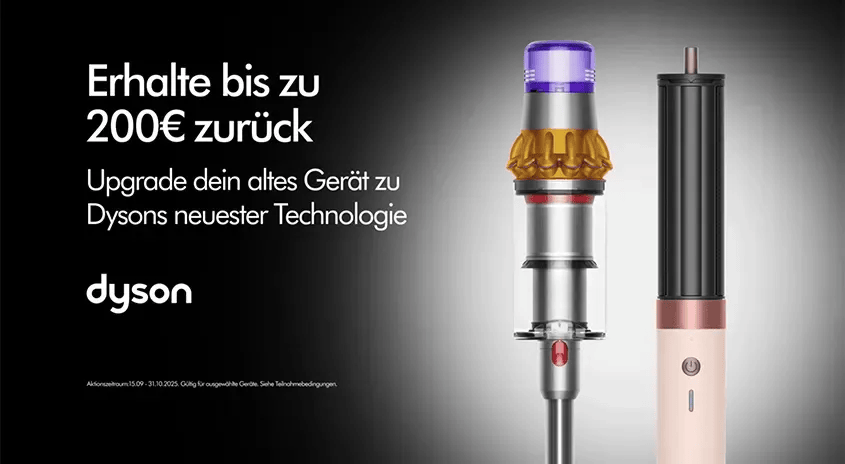
The partnership also enables an attractive cashback system. MediaMarkt customers receive up to €200 per device for trading in Dyson devices, depending on the model, age, and condition. This increases participation rates and motivates customers to return their old devices.
The cooperation creates a real win-win effect: Dyson retains control over returns, recovers valuable materials, and strengthens customer loyalty. MediaMarkt benefits from additional customer traffic and an attractive service offering.
The same model, one size smaller
Tchibo buys back used coffee machines, refurbishes them, and resells them profitably. With koorvi as the infrastructure behind it.
👉 Read the Tchibo success story
What Lessons Does the Program Offer for the Industry?
Dyson’s approach shows how trade-in programs can be strategically integrated into corporate logic beyond mere take-back. Other electronics manufacturers can learn how refurbishment, cashback incentives, and partner integration can be combined to achieve both economic and ecological goals. Those who implement circular business models early can secure competitive advantages, minimize regulatory risks, and be perceived as pioneers in sustainability.
Tools and platforms that simplify trade-in, quality control, and logistics, like those from koorvi, can accelerate program launch and scaling.
To find out how your brand can implement similar circular solutions, take our Circularity Check or contact us to start your journey toward profitable sustainability.
How Is Dyson Further Expanding Its Circular Model?
Since November 2025, Dyson has launched an innovative cooperation in collaboration with Raylo in the UK: customers can use selected Dyson devices through a flexible subscription model instead of buying them outright. The devices are offered refurbished, which extends their lifespan and saves resources. At the end of the subscription, the devices can be returned, reused, or properly recycled. This model combines sustainability with convenience and allows customers to always stay up to date with the latest technology without committing permanently to a product.
Trade-in started as a pilot with a single retail partner. Within a year, it has grown into cashback returns, in-store trade-in, and a refurbished subscription model across multiple markets. That is the pattern worth copying: start small, keep control of the returning products, and add channels as the economics prove out.
Not ready to talk yet? Get the Recommerce Playbook for the step-by-step setup.
%201.avif)