Summary
Panasonic does not give up control after the first sale the company takes it back. Returns, B-stock and used devices are not left to the market, but systematically transferred into Panasonic’s own second-life programs. The decisive step happens before recycling: this is where Panasonic’s new value creation begins.
%202.avif)
Why recycling was no longer enough
Panasonic started with recycling and quickly encountered a structural limit. In recycling facilities, it became clear that many devices were already being dismantled even though they had barely been used. Functional, repairable, economically still valuable and yet removed from the market. The problem is not recycling itself, but timing: it comes too late and destroys value. Based on this insight, Panasonic consistently shifted its focus upstream. Instead of looking at products only at the end of their lifecycle, the company now organizes targeted takeback before disposal. The focus is on the decision of whether reuse makes economic sense or recycling becomes necessary.
Panasonic’s refurbishment approach
In a former TV factory, products are now systematically refurbished, deliberately in the same place where new products used to be manufactured. It shows that refurbishment is an equal step in the process. For refurbishment, Panasonic selects product categories with a clear quality standard. These include televisions, washing machines, refrigerators, dishwashers and digital cameras. The devices come from clearly defined return streams: technical returns, display units from retail, as well as Panasonic’s own subscription and leasing models. Panasonic refers to this approach of giving used devices a second life — industrially organized, brand-led and fully integrated into its own system as Factory Refresh.
How it works: From takeback to resale
- Bundling returns
Not with random used goods, but with predictable, known streams. - Device inspection
Each device is individually diagnosed and classified. Decision: refurbish or discard. - Device refurbishment
So called masters repair the devices, replace necessary parts and restore them technically and visually to Panasonic level. - Final quality assurance
Before release, the devices are tested again. - Resale under the Panasonic label
The devices return to the market as manufacturer-certified products, 30% cheaper than new goods, clearly positioned and with the manufacturer’s seal.
Refurbishment as a Data Engine for Product Development
Insights from real-world use
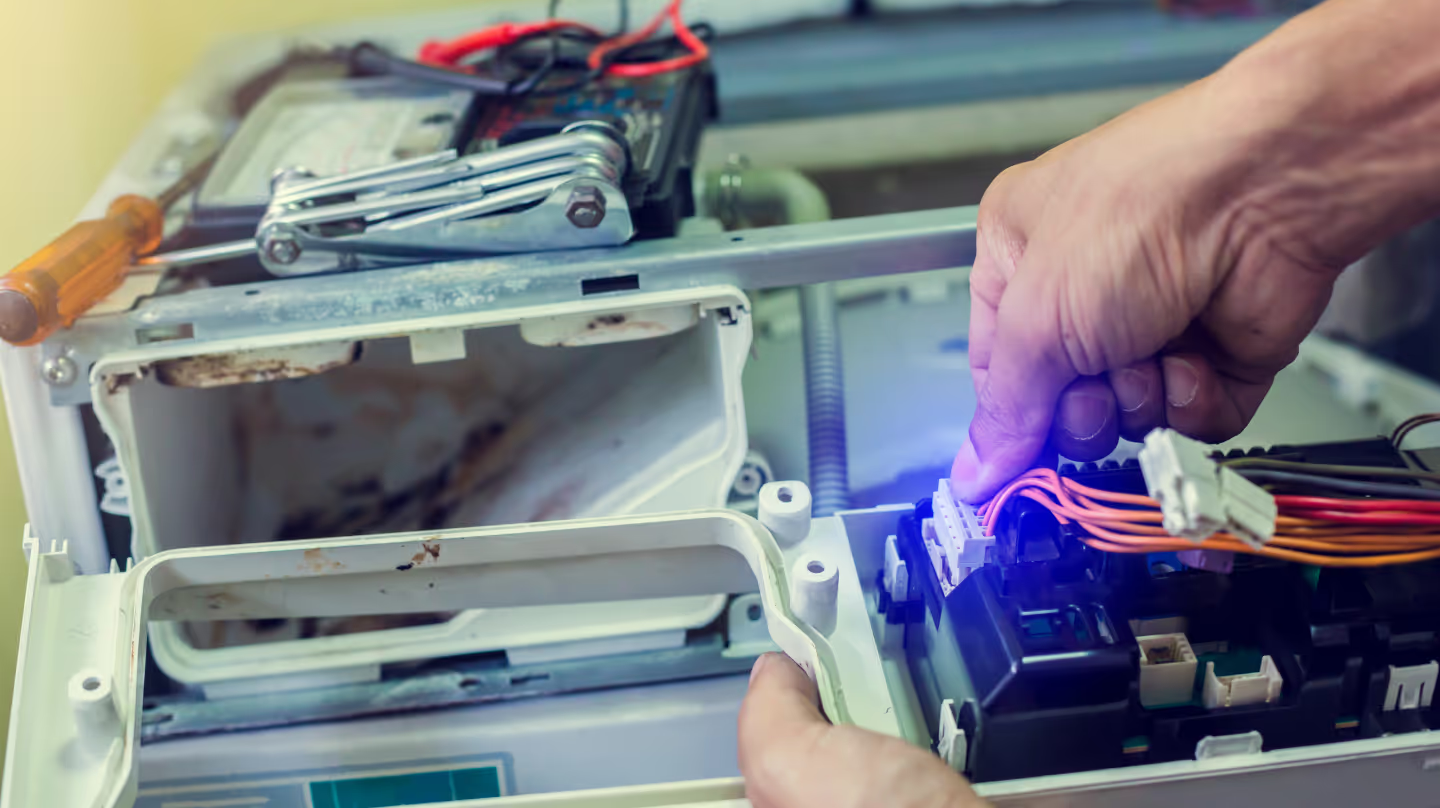
Each returning device is technically analyzed. It provides concrete data on how products function in real-world use: which functions are used, which components are particularly stressed, where wear occurs early, and which failure patterns repeat. These insights are more valuable than laboratory or simulation results because they reflect real usage.
Integration into product strategy and development
The data flows directly back into key areas. It influences design, material selection and modularity in product development, improves repair concepts and spare parts strategies in service, and supports the planning of lifespan and repairability. This creates a continuous feedback loop that secures technical decisions on a solid basis.
The second-life cycle thus becomes part of the product strategy. The secondary market is not only circular economy, but a development space: products are rethought and systematically improved in real operation.
Implications for product development
Repairability becomes the guiding principle of product development. Products must be designed in a way that they function across multiple lifecycles and remain economically usable. The focus shifts from optimizing the one-time sales price to optimizing the entire product lifecycle: durability becomes the central development goal. The secondary market becomes a feedback loop for development. Insights from usage flow directly back into design, architecture, and processes, making second life an integral part of modern product development.
Quality beats low-cost brands
Refurbishment works only where products are designed for quality from the very beginning. Cheaply produced devices fail early in the lifecycle: they are difficult to repair, have high failure rates, and quickly lose their economic value. Refurbishment thus becomes a stress test for product quality and a clear dividing line between sustainable brands and short-term low-cost strategies. This creates a structural advantage for manufacturers. Quality providers generate value across multiple lifecycles: through lower service costs, higher residual values, and additional revenues in the secondary market. Durable, repairable products secure long-term value creation and higher profitability, while low-cost brands systematically lose in the second life.
What manufacturers can learn from Panasonic
Control over the secondary market does not always mean operating one’s own facilities, but deliberately steering the second-life cycle. Manufacturers can achieve this control even without their own infrastructure by shaping takeback, refurbishment, and resale. This ensures that the secondary market is not left to chance or external platforms, but is designed as an integrated part of the business model.
A resale-as-a-service platform enables exactly this kind of control: it organizes takeback processes, sets quality standards for refurbishment, coordinates certified partners, and creates transparency regarding condition, residual values, and resale flows. At the same time, data from the second product life is systematically captured and made usable for product development, service, and cost optimization. This allows brands to retain strategic control over the secondary market without having to operate their own facilities.
Is Refurbishment Worth It?
Companies that systematically integrate takeback, refurbishment, and resale transform products into recurring value creation. Profit is generated not only at the first sale, but across the entire product lifecycle.
👉 Take the Circularity Check or contact us to find out how koorvi helps you manage resale and secondary markets profitably.