Summary
Few product categories suit resale as well as photography gear. Cameras and lenses are durable, high-value, and hold their worth for years. Yet most manufacturers leave the entire secondary market to external platforms. This article shows how large the market for used cameras has become, why photography gear is almost engineered for resale, and what a brand-owned program looks like that keeps the margin in house.

The used camera market is large, and it is growing steadily
The global market for used cameras and lenses reached around 9.2 billion US dollars in 2025 and is projected to grow to 15.6 billion by 2035, at an annual rate of 5.3 percent (GMInsights). This is no longer a niche. It is a distinct, expanding sales channel.
The composition is what matters. Used and pre-owned gear accounts for roughly 68 percent of this market. Europe holds about 32 percent of the global share, or around 2.5 billion US dollars. National figures for individual markets are scarce, but the direction of travel is clear and consistent.

Who buys? A large share are beginners and students entering photography on used equipment. That same group later becomes the buyer of new premium bodies. The used market is not a competitor to new sales. It is the entry rung that feeds them.
Photography gear is practically built for resale
Cameras meet the single most important resale criterion almost perfectly: their lifespan is far longer than the time the first owner actually uses them. A body works reliably for 10 to 15 years. A good lens easily survives three camera generations with almost no loss in optical quality.
Then there is value. Photography gear sits well above the 250-euro threshold at which refurbishment makes economic sense. A single professional lens can cost 1,500 to 2,500 euros new and is still worth several hundred euros years later. That makes reconditioning worthwhile every time.
The gear is also modular. Bodies, lenses, flashes, and accessories can each be inspected, cleaned, calibrated, and put back on sale individually. Clear, established quality grades give buyers something to trust. Few categories lend themselves so neatly to a structured refurbishment program. The same logic applies to the audio category, which follows the very same patterns.
Right now, a third party is collecting your margin
This is the real problem for manufacturers. The used camera market already exists. It simply runs without the brands. Platforms like MPB, KEH, rebuy, and Back Market have claimed the space.
One example shows the scale: MPB alone recirculated around 615,000 cameras, lenses, and accessories in its 2025 financial year, up 9 percent year over year (Digital Camera World). Every one of those transactions is margin, customer data, and a brand touchpoint that lands with a platform instead of the manufacturer.
Leaving the secondary market to third parties means giving up three things: control over how your own products are priced, the relationship with the second generation of buyers, and the data on which models stay in use and for how long. Resale happens either way. The only open question is who profits from it.
What Canon, Nikon, and Fujifilm already get right
Some manufacturers have understood this. Canon runs one of the most extensive brand-owned refurbished stores for cameras and lenses. Nikon operates its own refurbished outlet, and Fujifilm sells reconditioned cameras and lenses directly through its own shop (Shutterbug).
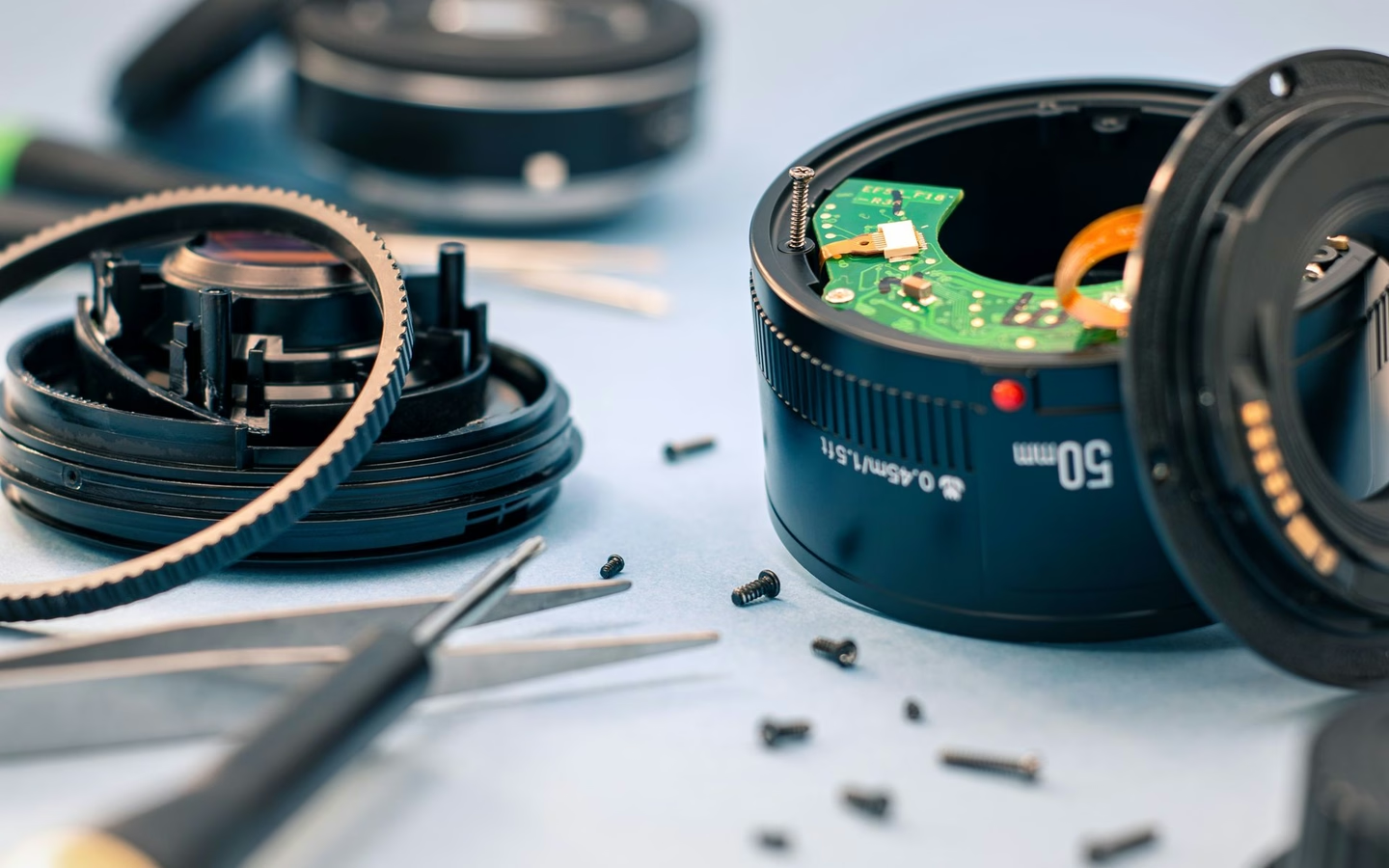
The quality argument is stronger than many assume. Refurbished gear from the manufacturer is often reconditioned to repair-service standard, which is higher than the basic manufacturing standard. Every unit goes through individual inspection. A brand-owned refurbishment is therefore not a compromise. In parts it is a quality promise that a pure third-party platform cannot make.
How seriously Canon takes reuse shows elsewhere too. In its B2B printer business, Canon has run one of Europe's most professional remanufacturing programs for over 25 years, with 90 percent reused parts and more than 50,000 reconditioned devices. In our conversation for the Reuse Playbook, Thomas Wagner, Sustainability Manager DACH at Canon EMEA, made one point that applies directly to cameras: without control over the return flow, there is no scalable reuse. That return flow, meaning the structured trade-in from the customer, is exactly where most refurbished stores stop. They sell reconditioned gear, but they do not actively organize the buy-back.
What a brand-owned resale program for cameras looks like
A working program closes the loop from buy-back to resale without the brand handing over control. In practice it needs four building blocks.
First, a trade-in portal inside the brand's own world, where customers get their old gear valued and hand it in for a voucher or a payout. Second, reliable refurbishment, whether through dedicated partners or existing service structures. Third, multi-channel resale across the brand's own storefront and additional channels such as refurbed or eBay. Fourth, a dashboard that makes conversion, cost, and margin visible.
This is exactly what koorvi delivers as Resale-as-a-Service: the software, the refurbishment, and the consulting in one package. The brand keeps the customer relationship, the data, and the margin. The secondary market that already exists turns from a margin leak into a second revenue stream.
Photography gear is one of the cleanest resale categories there is: high-value, durable, modular, and backed by a market that is demonstrably growing. The question for manufacturers is not whether their cameras get a second life. It is whether they earn from it themselves. If you want to see what a brand-owned resale program for your products could look like, let's talk.