Summary
There is no single EPR number in Germany. If you are searching for how to get an EPR number, you are usually looking for a process that is in fact several parallel registrations. Extended Producer Responsibility (EPR) in Germany splits into three separate areas: packaging, electrical equipment and batteries. Each area has its own register, its own number and its own authority. This guide walks you through registration step by step, with the deadlines, costs and penalties you need to know before your first product reaches the German market.
One thing up front, because it is the most common mix-up: "EPR number" is an umbrella term. Under German law you get a LUCID number for packaging, a WEEE registration number (WEEE-Reg.-Nr.) for electrical equipment and a battery registration number (Batt-Reg.-Nr.) for batteries. Which ones you need depends on what you sell and how you ship it.

Step 1: Check which EPR obligations actually apply to you
Before you apply for anything, work out which of the three obligations applies. Most producers and distributors are affected by more than one, often by all three at once.
| What you place on the market | Register / Authority | Number | Legal basis |
|---|---|---|---|
| Packaged goods (incl. shipping boxes and pure B2B transport packaging) | LUCID, Central Agency Packaging Register (ZSVR) | LUCID number (DE + 13 digits) | VerpackG |
| Electrical and electronic equipment | stiftung elektro-altgeraete register (stiftung ear) | WEEE-Reg.-Nr. DE | ElektroG |
| Batteries and accumulators (incl. built into a device) | stiftung ear | Batt-Reg.-Nr. | BattDG / EU Battery Regulation 2023/1542 |
The rule of thumb: a single shipping box already makes you subject to packaging registration. Since the reform of 1 July 2022, the LUCID registration obligation applies to all types of packaging, including pure transport and B2B packaging. Anyone selling devices with a built-in battery is usually affected by all three areas.
Step 2: Register packaging with LUCID
Packaging registration is the most common and the simplest part. It runs in two steps that you must not confuse: the registration in the register, and the contract with a dual system.
- Register in the LUCID packaging register. You create an account online with the Central Agency Packaging Register (ZSVR) and enter your company and brand data. Registration is free and usually takes 15 to 20 minutes. Your LUCID number (format: DE plus 13 digits) typically arrives by email within around 24 hours.
- Sign a contract with a dual system. Registration alone is not enough. You also have to license your packaging volumes with an approved dual system (for example Interzero, Reclay, Der Gruene Punkt). This license is paid and scales with the volume and material of your packaging.
- Report your volumes. You report identical packaging volumes to the dual system and to LUCID. Both reports have to match, otherwise you risk a complaint.
Important for foreign companies: you must complete the LUCID registration yourself. Unlike in many other EU countries, it cannot be handled by an authorised representative.
Step 3: Register electronics with stiftung ear
If you place electrical or electronic equipment on the market, you need a WEEE-Reg.-Nr. from stiftung ear before your first sale. Without this number you are not allowed to sell, and marketplaces will not onboard you without proof.
- Classify your device type and B2B/B2C status. During registration you choose whether you are a producer or an authorised representative, and you assign your products to device categories. The B2C or B2B classification decides how much effort is involved.
- Provide an insolvency-proof guarantee (B2C only). Producers of B2C devices must provide stiftung ear with an insolvency-proof guarantee for later disposal. That is a separate cost block. B2B devices face milder obligations and do not need this guarantee.
- Apply and wait for the decision. Once all requirements are met, you receive the registration decision with your WEEE-Reg.-Nr. DE. Plan ahead: processing can take several weeks to months.
After registration, you must state your WEEE number whenever you offer devices or issue invoices. ElektroG obligations go beyond registration, all the way to taking back end-of-life devices. What that means in practice for producers and retailers, we covered in our ElektroG overview.
Step 4: Register batteries, and do not miss the deadline
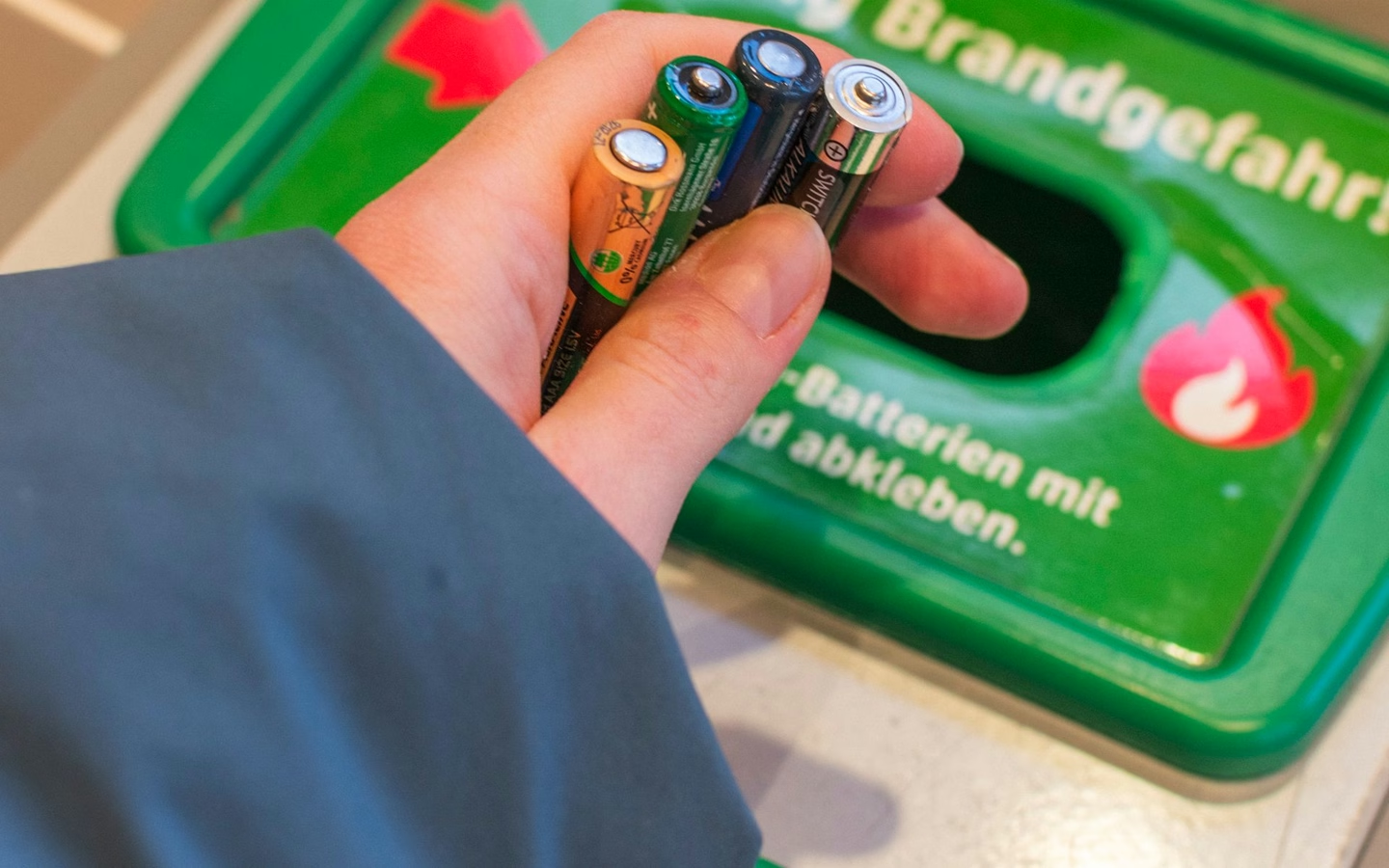
Battery law changed in 2025, and this is where most deadlines are falling due right now. The German Battery Act (BattG) was replaced on 7 October 2025 by the Battery Law Implementation Act (BattDG), which transposes the EU Battery Regulation 2023/1542.
- Register with stiftung ear. Battery registration also runs through stiftung ear, with its own Batt-Reg.-Nr. It applies to batteries built permanently into a device as well.
- Assign each battery category to a system. You must join an approved take-back system and assign each relevant battery category to a producer responsibility organisation. The classification has grown from three to five categories (portable, industrial, starter/SLI, electric-vehicle and LV batteries).
- Mind the deadline: 15 January 2026. Existing registrations had to be transferred to the new law and each category assigned to an approved system by 15 January 2026. If you did not migrate your old registration, you count as unregistered.
The EU Battery Regulation has applied directly since 18 February 2024. Beyond registration, it introduces further obligations such as the digital battery passport, which phase in over the coming years.
Step 5: Foreign companies, the authorised representative
If your company is not based in Germany, you need a Germany-based authorised representative for electronics and batteries to take on the EPR obligations for you. For packaging, the exception from Step 2 applies: you must complete the LUCID registration yourself, an authorised representative may not do it. With the EU Packaging Regulation (PPWR), the role of an authorised representative for packaging additionally comes into play from 2026, a point foreign sellers should have on their radar now.
Step 6: Keep your numbers active and report
An EPR number is not a one-off act. You only keep it valid by reporting and licensing on an ongoing basis: packaging volumes to LUCID and the dual system, electronics and battery volumes to stiftung ear. If a report is missing or the figures do not match, the number can become invalid, and with it your right to sell.
What happens if you skip it
EPR violations are not minor matters. They are prosecuted as administrative offences, and the fines are high. On top of that comes the quiet lever of the marketplaces: Amazon, eBay and Kaufland require EPR numbers as proof and block listings without them. A blocked listing costs you revenue from day one, long before any authority gets involved.
| Violation | Maximum fine | Additional risk |
|---|---|---|
| Packaging without LUCID registration or system participation | up to 100,000 / 200,000 euros per violation (VerpackG) | Sales ban, profit recovery |
| Electronics without WEEE registration | up to 100,000 euros per violation (ElektroG) | Sales ban, warning notice |
| Batteries without registration or volume reporting | up to 100,000 euros per violation (BattDG) | Profit recovery |
| Missing EPR number on marketplaces | no fine, but immediate listing block | Lost revenue from day one |
From compliance burden to margin channel
EPR is built as an obligation, but the logic behind it is the same as resale: you are responsible for your product until it reaches the end of its life, take-back included. If you have to organise that take-back anyway, you can treat it as a pure cost line or use it as an input stream for a resale program. This is exactly where compliance turns into a margin channel: the devices you take back by law can be refurbished and resold across owned and external channels instead of being disposed of. For how EPR and circularity obligations fit together in Germany in 2026, see our EPR overview for Germany.
Registration is mandatory. What you do with the return channel afterwards is a strategic choice. If you want to know whether your take-back obligation can become an economically viable resale program, talk to us. We will also tell you honestly when it does not pay off for your products.