Summary
H&M has already operationalized circularity not perfectly, but effectively. Take-back, resale, and recycling are established in the market. Result: more store traffic, additional revenue from second life, and reduced write-offs.
The problem: value loss after the first sale at H&M
H&M sells millions of products and then loses a large part of the value creation. After the first sale, the connection often breaks. Returns are written off, B-stock is discounted, and worn items move to external platforms. The second life cycle therefore often takes place outside of the company’s own system.
Especially in the fashion market, this is a structural problem. Volumes are high, product cycles are short and this is exactly where untapped potential arises. A large share of clothing is not re-commercialized by the brand itself, even though this is where additional revenue could be generated.
The result is clear: lost revenue streams, no control over the secondary market, and limited opportunities for re-engagement. Every missed second-life touchpoint is a missed repeat purchase.
How H&M is already implementing circularity today
H&M has recognized this gap and started to close it operationally. Not with a perfect end-to-end system, but with scalable building blocks in the market.
The key point: these initiatives are not only designed for sustainability, but are economically viable. Take-back drives traffic. Vouchers drive repeat purchases. Resale creates additional revenue streams. Recycling stabilizes long-term cost structures.
H&M does not show a finished circular system, but something more valuable:
how circularity can be built and monetized step by step.
How does take-back become a traffic engine at H&M?
H&M has scaled take-back globally, creating one of the strongest entry points into circularity. Customers bring clothing into the store, receive vouchers, and are directly incentivized to make their next purchase. The returned items are then systematically sorted: some go into resale, some into downcycling, and some into recycling.
The effect is clear and measurable. Take-back drives additional store traffic, vouchers drive repeat purchases, and at the same time create access to used products as a new supply source. The key point: this does not function as a sustainability initiative, but as a retention mechanism with direct revenue impact.
How is H&M already monetizing resale today?
H&M is already monetizing second-hand but not centrally, rather across multiple channels. Investments in resale platforms, own resale tests in sub-brands, and selected second-hand spaces in stores form a distributed system that is scaling step by step.
The economic effect is directly visible. It creates additional revenue without new production, while also generating valuable data on price depreciation, demand, and product lifespan. It also opens access to new customer segments that are difficult to reach through traditional channels.
The key point: resale is no longer an experiment, but already a functioning revenue channel.
Why does H&M use recycling as a sourcing strategy?
An often underestimated lever lies in the material itself. H&M invests specifically in textile-to-textile recycling, new fiber technologies, and the integration of recycled materials into existing collections.
This does not only impact perception, but directly affects the cost structure. Reduced dependency on virgin materials leads to more stable purchasing prices and lower sourcing risk. At the same time, regulatory security increases in a market with growing requirements.
Circularity is not used here as marketing, but as a lever for COGS and supply stability.
How does H&M test new revenue models with rental & repair?
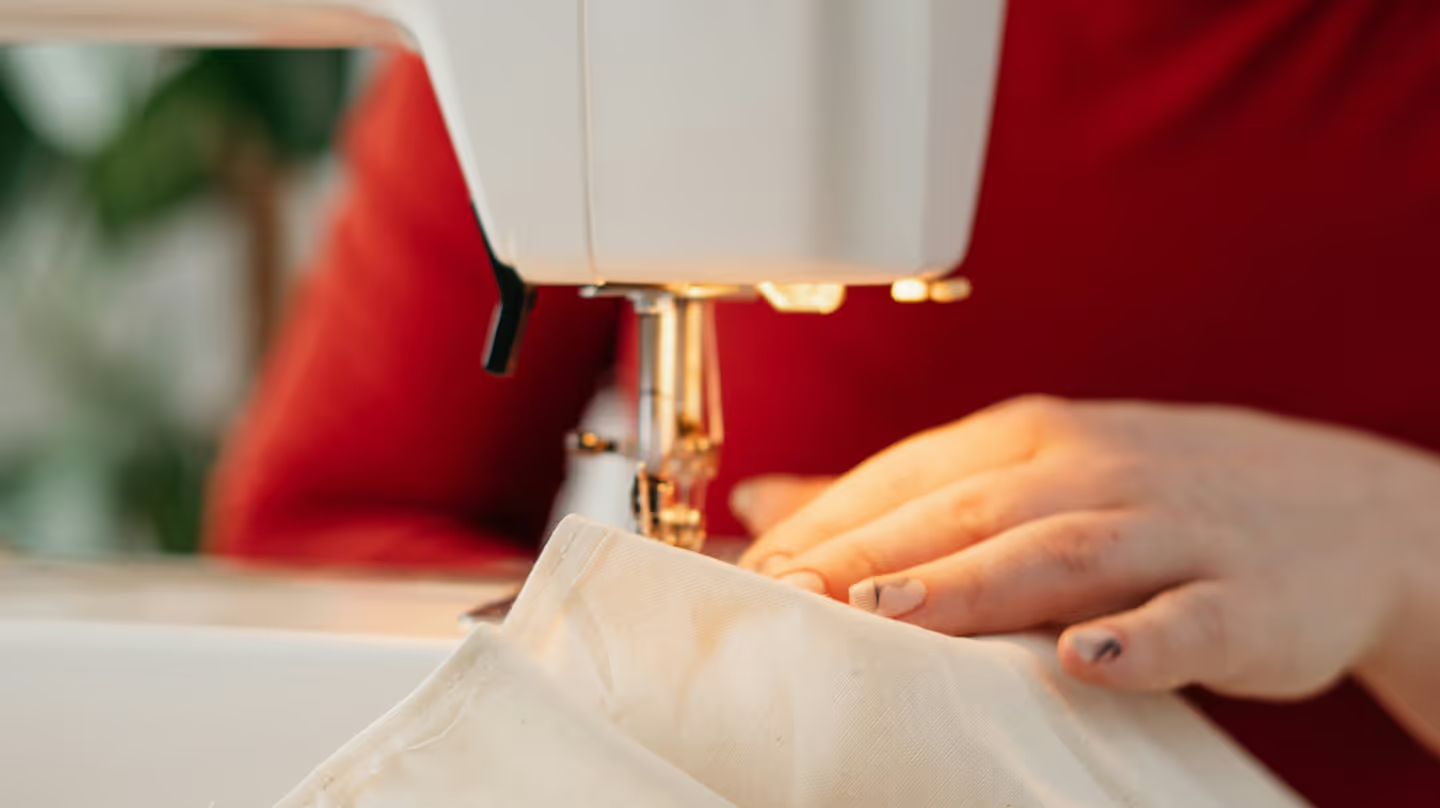
In addition to take-back and resale, H&M is also testing models that go one step further. Rental offers for selected collections and in-store repair services actively extend the usage of a product.
This changes the revenue logic. A product is no longer sold once, but monetized multiple times. At the same time, additional touchpoints are created לאורך the usage phase without new production.
The effect: more revenue per asset and stronger customer loyalty across the entire lifecycle.
Why does this logic work economically?
H&M shows: circularity works when it directly impacts revenue and costs , not as an add-on, but as an extension of the business model.
The mechanics are simple, but effective:
- Return → voucher → new purchase
- Take-back creates a direct touchpoint. The voucher lowers the purchase barrier and increases the likelihood of a quick re-purchase. Result: higher frequency and increased customer lifetime value.
- Resale → additional revenue
- Already produced goods are monetized a second time. Without new production costs, additional revenue is generated, often with attractive margins, since the initial cost has already been written off.
- Recycling → lower costs
- Recovered materials reduce dependency on virgin resources. In the long term, this stabilizes purchasing prices and reduces supply chain risks.
👉 The key point:
Circularity creates more revenue per product and more value per customer.
How does circularity really pay off?
Circularity pays off when it is implemented systematically. The leverage does not lie in a single initiative, but in the combination of take-back, refurbishment, and resale.
Companies that integrate these steps turn products into recurring value creation. Revenue is not only generated at the first sale, but across the entire product lifecycle, with every additional touchpoint.
👉 Many companies leave value on the table after the first sale. With the right processes, products can be taken back, refurbished, and resold — unlocking additional revenue potential.
Run the Circularity Check or contact us to find out how to manage resale and secondary markets profitably.

%201.avif)