
Summary
If your product pages, packaging or campaigns currently use terms like "eco-friendly", "sustainable" or "carbon neutral", you have until 27 September 2026 to change that. That is when the EU's EmpCo Directive takes effect, bringing a far-reaching ban on generic environmental claims in consumer-facing communication. This article covers what exactly gets banned, what remains allowed and why a resale program will be the most defensible sustainability claim a brand can make from September onwards.
What the EmpCo Directive is and when it applies
The EmpCo Directive (Empowering Consumers for the Green Transition, Directive (EU) 2024/825) is the EU's answer to a measurable problem: in a 2020 European Commission study, 53.3 percent of examined environmental claims were vague, misleading or unfounded, and 40 percent were entirely unsubstantiated (Norton Rose Fulbright). The directive adds twelve new banned practices to the EU's blacklist of unfair commercial practices, most of them targeting green claims.
The dates are fixed: member states had to transpose the directive into national law by 27 March 2026 (in Germany via an amendment to the Unfair Competition Act, UWG). From 27 September 2026, the new rules apply to all B2C communication, with no transition period (Cooley). Violations can trigger cease-and-desist actions, injunctions and fines of up to 4 percent of annual turnover.
One thing worth stressing: the directive applies wherever your brand talks to consumers. Product pages, packaging, ads, social media, newsletters. If you manufacture or sell in the EU, you are in scope, regardless of where your company is headquartered.
These claims are banned from 27 September 2026

The blacklist hits exactly the phrases that sit on every second product page today (Carbon Trust):
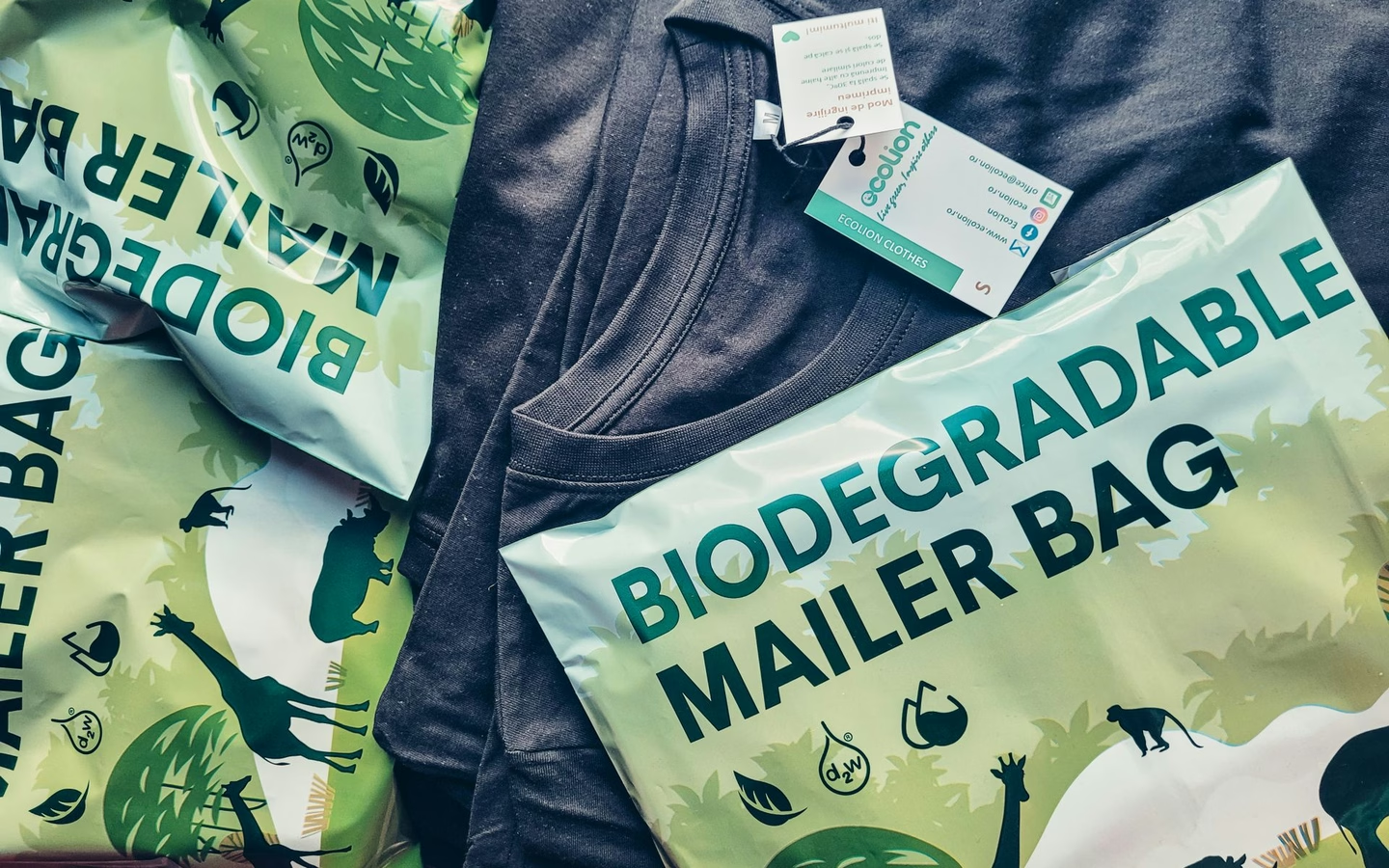
- Generic environmental claims without recognized proof. "Eco-friendly", "green", "natural", "biodegradable": all prohibited unless you can demonstrate recognized, excellent environmental performance.
- Carbon neutrality claims based on offsetting. Claims like "carbon neutral", "CO2 neutral" or "climate positive" are banned outright when they rely on offsetting projects rather than actual reductions in your own value chain.
- Self-invented sustainability labels. Logos and badges without a public authority or certified scheme behind them are no longer allowed.
- Vague future promises. "We will be carbon neutral by 2035" only works with a publicly available, externally verified implementation plan.
The common thread: the EU is not banning sustainability in advertising. It is banning unsubstantiated sustainability in advertising. That distinction decides who comes out of September looking good.
The Green Claims Directive is gone. That does not make things easier.
Many people confuse the EmpCo Directive with the Green Claims Directive, which was meant to define detailed verification procedures for environmental claims. The Green Claims Directive was withdrawn by the Commission in 2025 (Gasilov Group). Anyone who read that as an all-clear got the wrong message.
The result is not less regulation, but less clarity. The EmpCo bans still apply, but the standardized procedure that would have let companies certify their claims no longer exists. What remains is a simple rule of thumb from competition lawyers: the more generic the claim, the higher the risk. The more specific and provable, the safer.
For you, that means the safest path through the new rules is not better wording. It is better evidence.
What remains allowed: specific, measurable, product-level claims
The good news: specific and verifiable claims remain legal. "This housing is made of 70 percent recycled aluminium" still works after September 2026, as long as you can prove the 70 percent. So does "We refurbished and resold over 3,000 products in 2026". The label is banned, the fact is not.
This is where the topic flips from marketing to operations. A copywriter cannot invent a concrete number; it has to come from a real process: from production, from the supply chain, or from the second life of your products. Brands that run such processes only need to rephrase their communication. Brands that do not will simply have nothing legal left to say come September.
We covered the fundamentals of credible circularity communication in this guide. EmpCo turns that discipline from optional into mandatory.
Why resale is the most defensible sustainability claim a brand can make

A resale program produces, as a by-product, exactly what the EmpCo Directive demands: concrete, product-level, documented facts. Every Trade-In, every refurbished product and every resale is a data point you can prove. Instead of "we are sustainable", you say: "2,400 strollers got a second life through our Trade-In program, as of Q2 2026."
Claims like that are not just legally safe, they are more credible. An avoided new production run is a real, physical saving, not a purchased certificate from an offsetting project. While competitors scrape "carbon neutral" badges off their packaging, a brand with a resale program can expand its sustainability communication, with numbers instead of adjectives.
For that to work, the numbers need to be captured cleanly. That is the infrastructure koorvi provides as Resale-as-a-Service: a Trade-In portal inside your own brand environment, refurbishment through our partners or your existing ones, and a dashboard that documents every take-back, every refurbishment and every resale. The dashboard built to track conversion, costs and margins doubles as your evidence archive for every environmental claim. What branded resale delivers strategically anyway gains a second function under EmpCo: compliance.
EmpCo is also part of a bigger pattern. Right to Repair mandates repairability, the ESPR brings the Digital Product Passport, and the proposal for the EU Circular Economy Act lands in Q3 2026 (European Parliament). The direction is unmistakable: the EU rewards brands that run circularity operationally and penalizes brands that merely claim it.
What to do before September 2026
Three steps, in this order. First: audit. Go through every consumer touchpoint (product pages, packaging, ads, social) and list every environmental claim. Anything generic gets cut or backed with evidence. Second: build your proof. Check which concrete, measurable sustainability facts your company already produces, and where data is missing. Third: build operations that generate provable facts, instead of hunting for wording that barely passes.
The EmpCo Directive ends the era in which sustainability was a copy block. From 27 September 2026 it is an evidence issue, and evidence comes from operations, not marketing. A resale program is one of the fastest ways to turn real circularity into real, legally safe communication. Want to know which provable numbers a resale program would generate for your brand? Let's have a quick chat.