

Summary
Apple is known for sleek design, innovation, and billion-dollar product launches.
But there’s a lesser-known story happening behind the scenes, and it’s one that every business should pay attention to.
Through its Trade-In and Recycling Program, Apple is not only reducing e-waste but also tapping into a highly profitable, circular business model. Refurbished iPhones, MacBooks, and iPads are now driving new revenues, opening new markets, and lowering production costs, all while improving customer loyalty and brand image.
Let’s break down how it works, and how your company can follow their lead.

What is the Apple Trade-In Program?
At its core, the Apple Trade-In Program allows customers to return their old devices: iPhones, MacBooks, iPads, even some Android phones, in exchange for store credit or free recycling. That sounds like a nice sustainability gesture. But for Apple, it’s a circular value chain in full swing.
When a customer returns a working device, Apple refurbishes it and sells it again as a certified pre-owned product, often to a new customer segment that prefers affordable or more sustainable options. If the device is no longer usable, it gets disassembled by Daisy, Apple’s advanced recycling robot, which can break down up to 200 iPhones per hour and recover high-value materials like aluminum, copper, and rare earth elements.
These materials are then reintroduced into the supply chain, powering the next generation of devices. Many of Apple’s newest MacBooks, for example, are already made from 100% recycled aluminum.
Learn more here: Apple Recycling Program
How does Apple’s Trade-In Program work?
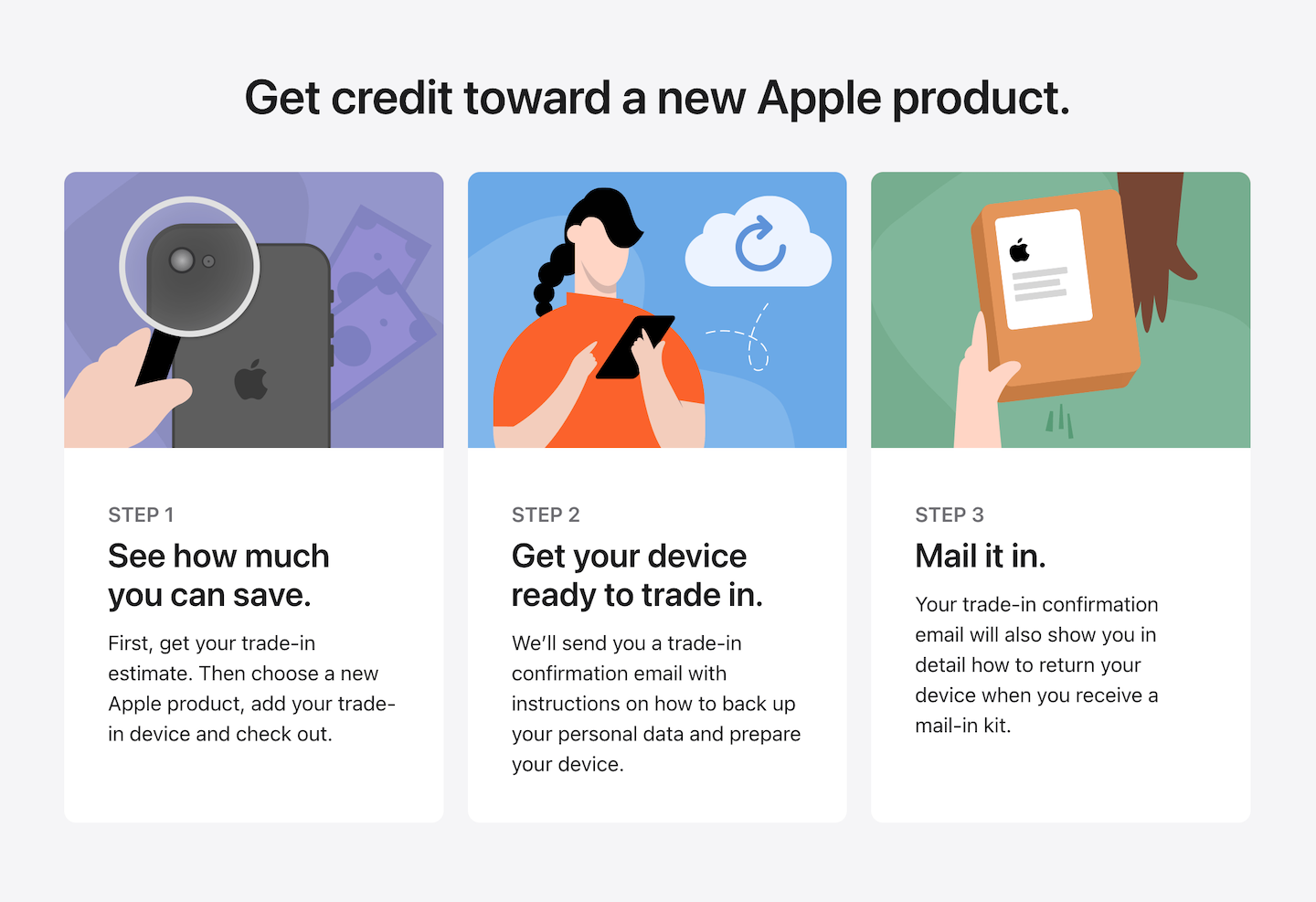
From a user’s perspective, Apple’s Trade-In process couldn’t be easier. It starts online, where customers choose their device, answer a few questions about its condition, and receive an instant estimate of its trade-in value. (you can get up to 750€!)
They then decide whether to bring the device to an Apple Store or ship it using a free, prepaid label provided by Apple. Once the device is received and inspected, the customer gets either a gift card or instant credit toward a new purchase. Devices that pass inspection go back into circulation. Those that don’t get responsibly recycled.
For the customer, it’s an effortless way to declutter and upgrade. For Apple, it’s a smart way to feed both its sustainability goals and its bottom line.
How does Apple benefit from its Trade-In Program?
On paper, it’s a recycling program. In reality, it’s a profit engine.
By recovering devices instead of sourcing new materials, Apple significantly reduces production costs. At the same time, it captures value from products that would otherwise be discarded, creating an entirely new revenue stream through refurbished sales.
According to Harvard Business School, refurbished iPhones don’t just appeal to budget-conscious consumers. They open doors to entirely new markets. Markets that maybe weren't ready to pay the high prices that Apple has on its items. And while most people associate refurbished devices with lower prices, the margins are often excellent: no marketing cost, no retail packaging, no R&D. Just smart reuse.
More importantly, this model strengthens Apple’s relationship with its customers. Offering trade-ins keeps people in the Apple ecosystem. It makes upgrades easier, and it reinforces a shared value around sustainability.
Want the playbook behind programs like this? Our free guide The Recommerce Playbook: From Returns to Revenue shows step by step how to turn trade-ins into a profitable resale channel. Download the free Recommerce Playbook →
Why are Trade-In Programs important?
Apple’s Trade-In Program proves that the end of a product’s life doesn’t have to be the end of its value. In fact, it can be the beginning of something smarter and more profitable.
The question is no longer if circular models work. It’s how fast your company can implement one.
Apple is not alone in this. Dyson runs the same playbook for vacuums and hair care, with cashback returns in Europe and in-store trade-in in the US. And Tchibo turns used coffee machines into a second revenue stream.
koorvi helps you get there, whether you're in consumer goods, fashion, electronics, or heavy industry.
How can I implement my own Trade-In Program?
Of course, building a system like Apple’s takes more than good intentions. It requires infrastructure: digital workflows, product evaluation logic, return tracking, resale automation, and more.
That’s exactly what koorvi provides.
Our platform enables companies to launch, manage, and scale their own trade-in or take-back program, with everything from customer-facing return tools to backend automation for sorting, refurbishment, and resale.
It’s a plug-and-play system designed for real-world logistics, with full integration into your inventory and customer systems.
👉 Get in touch with us to turn take-back into a business strategy. Not sure where to start? Take the 2-minute Circularity Check to gauge your resale potential.

%201.avif)